 Passo dello Stelvio/Stilfser Joch/Pass da Stielva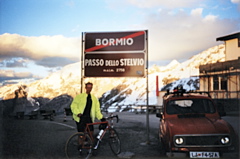
1558m - 21.2 km (Bormio)
1521m - 20.5 km (Premadio)
1396m - 16.4 km (Sta. Maria im Müstair)
The classical and hardest approach is from Prato to the east. It is actually more or less a constant climb all the way from Merano/Meran (323m) on this side. From Prato/Prad (909m) it is 7.5% on average with a maximum steepness at ca. 15-16%. There are 48 numbered hairpin bends on this side, while there are ca. 38 unnumbered from Bormio (1200m) to the west where it is almost as steep with 7.4%. The Bormio side has a couple of short tunnels early on, but most are galleries and the others are lit. If you come down from Passo di Foscagno/Pass da Fus-chagn (2289m) or Passo Torre di Fraele/La Bocchetta (1938m), the shortest way is to descend through Ponte di Premadio (1237m) and climb a small road up to the normal Bormio-Stelvio road.
The pass can also be climbed from Sta. Maria im Müstair (1376m) in Switzerland on a road that has recently been fully asphalted. The Swiss side takes in the highest paved Swiss pass – Pass Umbrail/Giogo di Santa Maria/Wormser Joch (2501m). The Swiss climb is more irregular than the Italian ones.
This is probably the most classic and popular of all mountain climbs in the world, and there are good reasons for it. The approach from Prato is something you will remember! Just when you think you must have climbed a very large part of the climb and passed some really steep sections, then you reach the first hairpins. After struggling up past the first 2-3 steep bends, you find a marker stating it is now 10 km left (I did see such a line on my first climb in year 2000) and you bend your head up and see in the sky what is all too obvious the place of arrival. It is really impressive and you feel the work needed to get there will have to be equally impressive on your part.
The Prato side is the most beautiful one. The Swiss side is the most quiet and lonely one. Fill up your water bottle before the climb on each side (there may be some water at one or two places on each side along the way). You can continue 380m on asphalt to the Tibet Hütte (2783m) with lovely views in good weather of the hairpins up the east side (for some reason I have not yet been there, but likely the next time!).
For those who want to explore an even higher gravel road, then you can visit nearby Pirovano (3021m) and on the way there you collect another pass, the Passo delle Platigliole (2908m). If it is dry and no snow, there is only one ramp too steep and bad for use with a road bike (conditions may change). Other names for the pass are: Giogo dello Stelvio/Stilfserjoch/Pass dal Stelvio.
[IT-BZ-2758, BIG 697]